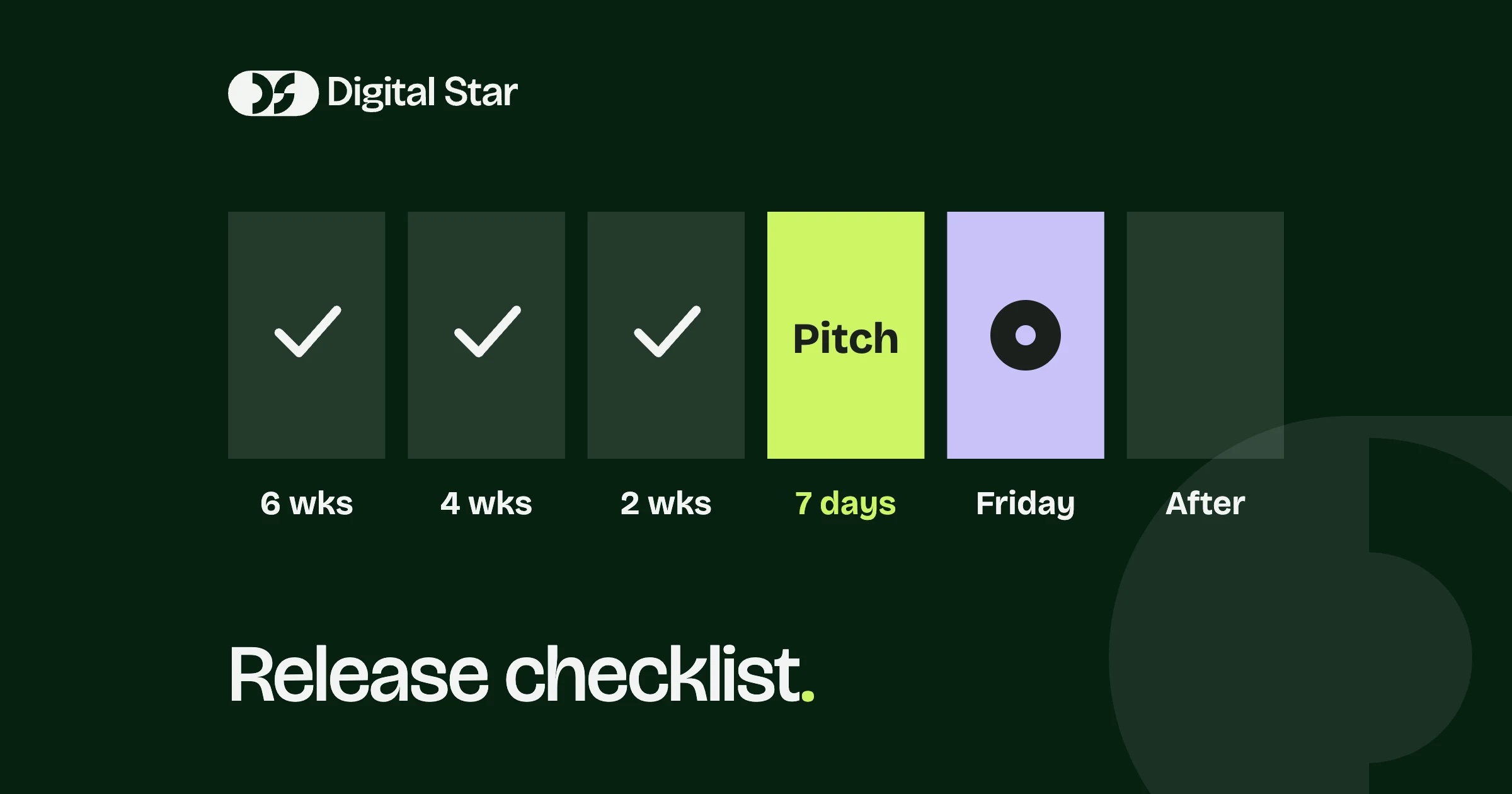
Every step to release a song or album in the US, in order: the rights that pay you, how to pick a distributor, the pitch deadlines and what to do the week it comes out.
Most release guides you'll find are written by a distributor or a pitching service, and they end by recommending themselves. This one isn't selling either. I've run release campaigns for Todd Snider, The Band of Heathens, Hayes & The Heathens, Hard Working Americans and KIMOCK, and this is the setup I'd want done before any of them went out. Every rule and price below links to the company's own page, and I checked them on October 13, 2026.
In this post:
- What to finish before you upload anything
- The four places your money comes from in the US, and the two most artists miss
- Ten distributors side by side, with what happens when you stop paying
- The pitch deadlines for Spotify, Apple Music and Amazon
- Pre-saves, playlist pitching services and what to skip
- Release day and the weeks after
What should be finished before you upload?
A distributor won't check your mix. Get these done first, because changing them after delivery means a takedown and a new upload.
- The master. Listen on headphones, studio monitors and a phone speaker. Make a clean version if there's explicit language.
- The artwork. Square, at least 3000 by 3000 pixels, and readable at thumbnail size.
- The credits. Every writer, producer, featured artist and engineer, spelled the same way everywhere.
- A split sheet. A signed page that says who wrote what share of the song. Do it before release, while everyone agrees. No PRO publishes an official template, so a simple signed document works.
- Clearances. Samples need permission before release. A cover needs a mechanical license (the license to record someone else's song). Your distributor may sell one, like DistroKid's cover song licensing, or use HFA Songfile. The 2026 US rate is 13.1 cents per copy, set in the Copyright Royalty Judges' 2026 adjustment.
Where does the money come from?
A song earns in four separate places in the US, and no single company collects all of it. Most guides stop at the first two. The last two are free to join and are where independent artists leave money on the table.
| What earns | Who collects it | Cost |
|---|---|---|
| Streams and downloads of the recording | Your distributor | Its fee or cut |
| Performances of the song (radio, venues, streaming) | Your PRO: ASCAP or BMI. SESAC and GMR are invitation only | Free for writers |
| Mechanical royalties from US streaming (the song, each time it's streamed) | The MLC | Free |
| Digital radio plays of the recording (SiriusXM, Pandora radio, webcasts) | SoundExchange | Free |
Join a PRO as a writer, and register the publisher side too. Performance royalties are split into a writer share and a publisher share. If you have no publisher, set up your own publisher account or the publisher half can go uncollected. ASCAP explains it on its join as a publisher page, and waives the publisher fee if you join as writer and publisher at the same time.
Join The MLC if no publisher or admin handles your songs. A PRO does not collect streaming mechanicals. The MLC does, and it can only pay you if your songs are registered with it. Check whether money is already waiting under your name with its artist lookup, and search your whole back catalog, not just the new song.
Do it before February 2027. The MLC plans to start paying out unclaimed money by market share in April 2027, oldest months first, using a snapshot of its database taken around February 10, 2027. Once a month is paid out that way, money that was yours goes to other rights holders by market share instead. Claims take about three weeks to process, so register early.
Register with SoundExchange twice. Once as the featured artist and once as the owner of the recording, if you own your masters. It pays for digital radio, not Spotify on demand plays. Self-released artists who skip the owner role miss the owner's share.
A publishing administrator like Songtrust registers your songs worldwide and collects the publisher share for a fee and a percentage. It's worth it if you have listeners outside the US or don't want to manage the registrations yourself. If you use one, it registers with The MLC for you, so don't register twice.
Use the same data everywhere. The song title, writer names and percentages have to match at your PRO, The MLC and your distributor. Mismatched data is how money ends up unmatched.
Which distributor should you use?
A distributor delivers your music to Spotify, Apple Music, Amazon and the rest, and pays you for the recording. Every YouTube release guide recommends one. Here are ten that take US artists without an application, from their own pricing pages on October 13, 2026. Prices change, so check the page before you pay.
| Distributor | How you pay | If you stop paying |
|---|---|---|
| DistroKid | From $24.99 a year, keep 100% | Releases come down, except ones you added its Leave a Legacy extra to, release by release |
| TuneCore | From $24.99 a year for a single. An album plan is $44.99 the first year, then $56.49 | Releases come down 42 days after a missed renewal, or the day the plan ends if you cancel |
| CD Baby | $9.99 per single, $14.99 per album, one time. It keeps 9% of streaming income | No yearly fee to stop |
| Symphonic | Starter plan $29.99 a year, keep 100% | Check its terms |
| UnitedMasters | From $19.99 a year, keep 100% | Check its terms. Its free tier stopped distributing in October 2025 |
| Amuse | From $23.99 a year | Music stays up, but Amuse takes 25% |
| Ditto | From $19 a year | Not taken down automatically, but renew to keep it up |
| LANDR | $24 or $45 a year, keep 100% | Says music stays live as long as you want |
| Too Lost | From $19.99 a year, keep 100% | Music can stay up, but you keep 85% |
| OFFstep (from ONErpm) | Free, or $18, $48 or $96 a year | Check its terms |
Spotify doesn't take uploads from artists directly anymore. It keeps a list of distributors it works with.
How to choose:
- One single and a tight budget: a one-time fee means nothing comes down later. A yearly plan is cheaper if you release often.
- A band splitting the money: make sure the plan pays splits to each member automatically.
- A catalog you want to keep up for years: read what happens when you stop paying before you upload. That's the line in the table that matters most.
- Ads to the release: if you'll use the distributor's pre-save page, check whether you can put your own ad pixel on it. DistroKid and LANDR say you can. If the help pages don't say, assume you can't.
Ask every distributor three more questions. If Spotify flags one song for fake streams, does it pull that song, the whole release or your whole catalog, and can you appeal to a person? Musicians have reported all three, including independent country and Americana acts who had albums pulled over streams they had nothing to do with. Does it pass Spotify's fake-stream fee on to you? Spotify has charged distributors per track for artificial streams since April 2024, and several pass it straight through. And can you take your music elsewhere later? You can switch without losing play counts if you keep the same audio, titles and ISRC and put the new copy up before the old one comes down. Spotify calls this track linking.
When should you upload?
Four to six weeks before release day. Spotify needs at least five business days to get music live, but you can't pitch editors until the song is delivered, and Apple wants 10 days for its pitch. Six weeks leaves room for a fix.
Release on a Friday. It's the global release day for new music. When you upload, your distributor will ask when it goes live: midnight in each country, or one moment worldwide. One worldwide moment usually means midnight UTC, which is Thursday evening in the US, so pick on purpose.
Let the distributor assign the ISRC (the code for the recording) and the UPC (the code for the release). Both are free. If you want your own ISRCs, the US ISRC Agency sells a prefix. Keep a list of every code, plus your final masters and artwork, somewhere that isn't your distributor's account. Musicians who had to switch in a hurry couldn't find the exact files to re-upload.
Send your lyrics through your distributor at upload so they show on Spotify and Apple Music from day one.
What do you do the day it's delivered?
Claim Spotify for Artists right away, not on release day. You need access to pitch. If this is your first release, Spotify lets you claim it with the upcoming release's UPC, or instantly through some distributors. Claim Apple Music for Artists too. Amazon Music for Artists can't be claimed by a new artist until the first release is public.
If you're in Spotify's Artist Profile Protection beta, turn it on. It emails you when music is delivered under your name, so another artist's song doesn't land on your page. One stricter setting holds releases until you approve them, so approve your own.
Register the song with your PRO and The MLC the same day, with the same title and splits you gave the distributor.
How do you pitch the editors?
Each service has its own window, and they don't line up.
- Spotify: pitch one unreleased song from the release. You must pitch at least seven days before release or the song misses your followers' Release Radar, and Spotify recommends at least two weeks. Making Release Radar eligible doesn't mean every follower sees it, because each listener's Release Radar holds a limited number of songs. Describe the genre, the mood, the instruments and the story, and say who it's for. Nobody can pay for editorial placement. Spotify's pitching rules.
- Apple Music: pitch at least 10 days before release for full consideration.
- Amazon Music: pitch one track up to 14 days after release. This is the one you can do on release day.
While you're in Spotify for Artists, add a Canvas, the short looping video behind the song, and set your Artist Pick. Spotify stopped taking new Clips in June 2026.
Do pre-saves matter?
A pre-save doesn't give the fan anything. The song shows up on release day either way. It helps you, because it tells the service people are waiting. So give fans a reason: an early clip, a signed print, first access to the vinyl.
Be careful with free pre-save links. The smart link a label or distributor makes for you usually carries their ad pixel, not yours, and the email signups go to them. Feature.fm's free plan covers one pre-save service and no pixel. Your own pixel starts on a paid plan. Linkfire includes pixels on every plan. I'd rather build the release page on the artist's own site, so the visit, the signup and the sale are yours. Here's how we build those pages.
Albums and EPs can also use a Spotify Countdown Page if the artist has at least 3,000 monthly active listeners. Singles don't qualify.
What content should you make?
Make short vertical videos built on the hook, not the intro. Twenty is a good target if you can keep it up. Post them before release and keep posting for weeks after. If one takes off, screenshot it that day. It's your proof if a spike in streams is ever questioned.
The most valuable thing you can build before release is a list of fans you can reach directly. A comment-to-subscribe post does that: a fan comments a keyword and gets the song in a message, then joins your email list. Here's how we set it up.
Have a short press kit ready: a bio, photos, the release story, links and a private stream. There's no official standard. When you email press, radio or bloggers, use the person's name, keep it short and say exactly what you're asking for.
Should you pay for playlist pitching?
You can pay for a listen. Never pay for a placement. Services like SubmitHub (about $1 to $4 per curator), Groover and Musosoup pay curators for their time, and the curator decides. Start with ten, read the feedback and adjust before you spend more.
Anyone who guarantees streams or placements is breaking Spotify's rules. Spotify can withhold royalties, remove the song and charge your distributor, and your distributor may charge you.
Spotify only pays a track that gets at least 1,000 streams in 12 months, so real listeners matter more than a big number.
What if your song gets flagged for fake streams?
It's one of the most common complaints in musician forums. A playlist they never pitched adds the song, streams spike for a few days, and weeks later the distributor sends a strike or takes the release down. In the longest Spotify Community thread on it, artists on DistroKid, TuneCore and CD Baby say Spotify and the distributor each pointed at the other. You can't stop a stranger from adding your song, but you can protect yourself:
- Check where your streams come from in Spotify for Artists every week for the first month.
- Watch for fake playlists: a spike that fades in days, plays from one city, a playlist you never pitched, big follower counts with tiny streams per song, and no real curator behind it.
- Report it the same day. Report the playlist to Spotify and email your distributor in writing, with the playlist link and the dates.
- Keep proof. Screenshot your stats, ads, press and playlist adds every week. One artist's streaming protection guide notes that a takedown can wipe your own dashboard.
- Ignore strangers selling promotion in your messages or comments.
Musicians have also reported flags after real ads, Spotify's own paid campaigns and a reel that went viral, even though Spotify says real promotion is fine. Keep a record of every ad and post that could explain a jump.
What happens on release day?
- Change every "pre-save" link to "out now": your bio, your site, your pinned posts and your email footer.
- Click every link yourself before your fans do. Open your artist page on each service and check the song is on the right profile, with the right art and lyrics.
- Pitch Amazon if you haven't, and claim Amazon Music for Artists if this was your first release.
- If you switched distributors, ask the old one to remove its YouTube Content ID claim, or your own videos can get claimed.
- Ask your distributor to request a YouTube Official Artist Channel if you don't have one.
- Lead with listening. For an album with a pre-order, the last chance to pre-order email is the sales push. Release day is when the message turns to the music.
What do you do after release?
Keep working the song after release day. Post the hook, share fan reactions and press, and play it live. A release keeps earning long after its first week.
Register the copyright. Copyright exists the moment the song is recorded or written down, so registering isn't required. But in the US you must register before you can sue, and registration makes statutory damages possible. Group registration for an album covers up to 20 songs for $65, and unpublished songs can be registered up to ten at a time for $85. See the fee list.
Sell on Bandcamp on a Bandcamp Friday, when Bandcamp waives its share. The next ones are November 6 and December 4, 2026.
Watch saves and where people are listening, not just stream counts, and plan the next release from what you learn. If you're putting out an album, plan the singles and the pre-order on one calendar.
Questions musicians ask
Do I have to register my copyright?
No. Your song is protected once it's recorded or written down. Register anyway if you want to be able to sue for infringement in the US.
How far ahead should I pitch Spotify?
At least two weeks, and never less than seven days, or the song misses your followers' Release Radar.
Do I need my own ISRC codes?
No. Your distributor assigns them for free. Keep a record of them, because you'll need them if you switch distributors.
Can I switch distributors without losing my streams?
Yes, if the new upload uses the same audio, titles and ISRCs and goes live before the old one comes down. Playlist placements aren't guaranteed to carry over.
Is there a free way to distribute music?
A few distributors have free tiers, but several have ended them since 2024. Read what a free plan takes in exchange, usually a percentage of your royalties.
Do I need a publisher?
No. Join a PRO as a writer, set up your own publisher account and register your songs with The MLC. A publishing administrator does that work for a cut if you'd rather not.
What should you do this week?
- Sign a split sheet for your next song.
- Join a PRO, The MLC and SoundExchange. All three are free for writers.
- Read what your distributor does if you stop paying.
- Put the Spotify pitch date, seven days out at the latest, on your calendar.
The upload is the easy part. The money and the fans depend on the setup around it, and most of it is free.